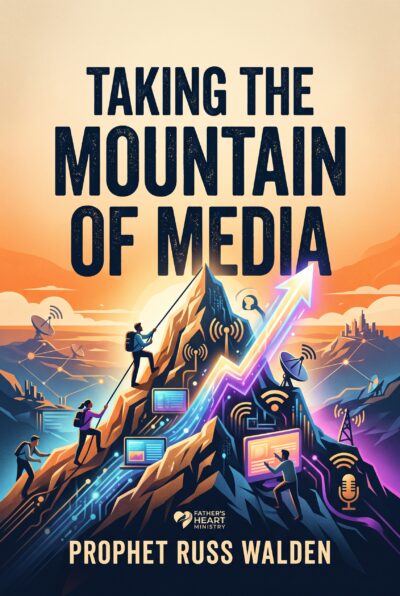
Father’s Heart Ministry Presents
Taking the Mountain of Media
What the First Christians Can Teach a Hesitant Modern Church
By Russell Walden
Run a thought experiment for a moment.
Imagine walking into a bustling city center in the middle of the first century—say, Corinth or Ephesus. You encounter a ragtag, underground group of believers making an announcement that fundamentally breaks every cultural, political, and philosophical category of their civilization.
Their central proclamation? The living God, the Creator of the cosmos, entered history as a Jewish carpenter, was publicly humiliated and executed as an insurrectionist and felon on a Roman cross, and then walked out of a sealed tomb three days later.
To the Roman mind, this was subversive treason. To the Greek intellectual, it was laughable foolishness. To the Jewish religious establishment, it was a scandalous stumbling block.
Yet this fringe movement didn’t just survive; it dismantled and rebuilt the ancient world. Behind that spiritual explosion was a mindset so bold, so daring, and so technologically agile that modern believers—often stereotyped as culturally defensive, risk-averse, and slow to adapt—barely resemble their spiritual ancestors.
01 Worldview
The Ultimate Conceptual Leap
Before we talk about technology, we have to talk about worldview.
If you are willing to stake your life on the claim that an executed criminal is the sovereign Lord of the universe, your capacity for paradigm shifts is already off the charts. The early church’s foundational message was the ultimate scandal. They did not settle for a safe, institutional, or socially palatable idea of God. They radically redefined power, glory, and holiness around a bleeding man outside Jerusalem’s city gates.
People willing to rethink the very nature of reality at that level were never going to be prisoners of traditionalism. They weren’t bound to “the way we’ve always done it,” because their entire existence was anchored in the most disruptive event in human history.
02 The Codex
Silicon Valley in the First Century: The Codex Disruption
That spiritual audacity spilled directly into everyday practice—especially in how the early Christians handled communication technology.
In the first century, the scroll was the gold standard. For centuries, sacred Scripture, philosophical treatises, and legal documents were rolled onto parchment. It was the respectable, holy, and time-tested medium of the era.
Then came an emerging piece of information technology: the codex (individual sheets bound together with a spine—what we know today as a book).
The Greco-Roman elite initially scoffed at the codex. It was dismissed as cheap, informal, and unfit for serious literature—used primarily for grocery lists, accounting ledgers, and rough notebooks.
The early Christians didn’t care about the social stigma. They saw Kingdom utility:
- Capacity: You could fit all four Gospels and the letters of Paul into a single bound volume, whereas doing so with scrolls required an entire armful of clumsy, expensive rolls.
- Navigation: A believer could flip back and forth between Isaiah and Matthew in seconds, instantly cross-referencing prophecy with fulfillment.
- Portability: A compact codex was easy to conceal, transport, and share across underground, persecuted networks.
While the rest of the ancient world dragged its feet for over two centuries, the early church adopted the codex immediately. In the second and third centuries, non-Christian writings were still roughly 98% scrolls; Christian manuscripts were nearly 90% codices. They were the premier early adopters of antiquity.
They applied the exact same boldness to Rome’s infrastructure. The empire built thousands of miles of paved roads and protected sea lanes to march legions and collect taxes. The early church didn’t boycott the imperial network—they hijacked it, turning military highways into a global distribution network for resurrection life and the Father’s love.
03 Today
Breaking Out of Modern Cultural Hesitation
Fast-forward to today.
Too often, the modern church approaches emerging technologies—digital platforms, artificial intelligence, interactive media, and new cultural frontiers—with reflexive suspicion. The default posture is frequently caution, critique, or retreat until a tool has been sanitized by years of institutional debate.
When preservation becomes a higher priority than proclamation, the message stagnates. We end up defending nineteenth-century methods as if they were first-century doctrines.
Discernment is essential, but fear should never dictate our strategy. The pioneers of our faith lived by a simple, uncompromising rule:
The message of the Gospel is eternal and unalterable; the medium is adaptable, practical, and disposable.
If the early saints possessed the spiritual courage to see the redemption of the world in a Roman execution stake, we can certainly look at modern media tools and ask:
✦ Ask the Father
Father, how do we use this to carry Your heart to the ends of the earth?
04 The Book
Step Into the Frontier: Taking the Mountain of Media
If you are ready to move from cultural defense to Kingdom offense, Russell Walden’s new book, Taking the Mountain of Media, is a strategic blueprint for this hour.
Discover how God is calling believers to reclaim influence, steward modern platforms, and boldly carry His voice into the cultural conversation rather than retreating from it.
Read it free: Experience the full interactive flipbook online right now at Father’s Heart Ministry.
Get your copy: Available worldwide on Amazon in Kindle, Audiobook, and Paperback editions (Pending).
Don’t sit on the sidelines of the digital age. Recover the innovative nerve of the early church and help take the mountain today.
Discover more from Fathers Heart Ministry
Subscribe to get the latest posts sent to your email.