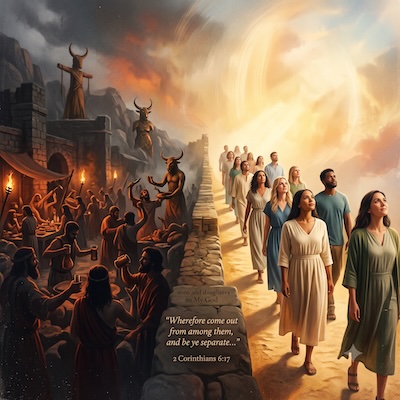
Set Apart: Understanding Covenant, Consequences, and Grace in 2 Corinthians 6
In 2 Corinthians 6, the Apostle Paul counsels the early Christian community regarding the intricacies of navigating interpersonal relationships within a surrounding pagan culture. In ancient Corinth, social life, civic duty, and commerce were deeply intertwined with pagan feasts and idolatrous practices. Recognizing the subtle, contaminating influence of these environments, Paul cautions believers against maintaining unholy alliances.
In verses 16–18, Paul provides the theological rationale for why separation is non-negotiable. Foreseeing the pushback from believers who had spent their entire lives immersed in these social customs, he anchors his exhortation in Scripture:
2 Corinthians 6:16–18 (KJV)“And what agreement hath the temple of God with idols? for ye are the temple of the living God; as God hath said, I will dwell in them, and walk in them; and I will be their God, and they shall be my people. Wherefore come out from among them, and be ye separate, saith the Lord, and touch not the unclean thing; and I will receive you, And will be a Father unto you, and ye shall be my sons and daughters, saith the Lord Almighty.”
The Conditional Nature of Covenant
Notice the relational conditional implied in the words: “I will be their God…”
While God is the universal Creator of all humankind, He is not automatically the covenant Father of everyone. Covenant requires a response. God took the ultimate initiative by sending Jesus Christ to pave the way. Our necessary response—once the light of the Gospel shines into our hearts—is to “come out from among them and be separate.”
This concept may challenge modern assumptions. Paul conveys a clear “if/then” principle: Do this, and I will do that.
What happens when a believer attempts to rewrite the terms? Consider the posture that says: “Lord, I love You and want You to be my Father—with all the peace, protection, and benefits that brings—but I have no intention of separating from the world. I don’t believe in ‘separation,’ and I choose to remain involved in things that Scripture and my own conscience declare unclean. But we’re still good, right?”
This poses a vital question: To what degree does the quality of your walk with God affect your actual experience of God?
The Danger of Compromise and Free Will
God honors human free will—it is one of the most potent gifts He has bestowed upon us. God will not force intimacy upon someone who consistently chooses distance through their actions and lifestyle.
When an unbeliever outright rejects God, believers readily recognize the spiritual tragedy. Yet, believers often make similar rejections by degrees. Through subtle compromise, we compartmentally exclude God from key areas of our lives—our finances, relationships, entertainment, and habits. Consequently, we forfeit His covering in those specific areas and reap the natural fallout. Whole destinies, callings, and divine potential can be derailed simply because we refused to align fully with His terms. This is the very definition of being lukewarm: attempting to enjoy covenant privilege while living in spiritual compromise.
Eternal Dimensions: Existence Without God
If someone chooses to live apart from God, what does that trajectory look like in eternity? Jesus addressed the reality of eternal covenant relationship in Matthew 22:32:
“I am the God of Abraham, and the God of Isaac, and the God of Jacob? God is not the God of the dead, but of the living.”
To reject God in this life is to choose an eternity modeled after that very preference. True hell is not merely physical anguish; it is the total, absolute withdrawal of God’s presence, light, and goodness. Can you imagine the sheer terror and darkness that ensues when God completely yields to human choice and withdraws Himself? In this life, that choice remains reversible; after death, it takes on eternal permanence.
The Mercy of Temporal Life
Why doesn’t a person who rejects God immediately experience the full weight of that judgment in the present moment? The answer mirrors why God barred fallen humanity from the Tree of Life in Genesis.
If Adam and Eve had eaten from the Tree of Life in a fallen state, they would have locked themselves into eternal rebellion without the possibility of change. By subjecting humanity to a temporal environment governed by time, decay, and change, God made redemption possible.
Just as the world was plunged into darkness through one man’s act of willful disobedience, God ordained that through the willful obedience of Jesus Christ, salvation could be offered to all. Our earthly lifespan is a divine mercy—a window of opportunity where finite beings can encounter the Infinite.
When we surrender to Jesus and yield to His call to “come out and be separate,” we move from boundary-bound limitation into His unmetered power. By aligning with His terms, our lives become conduits of His Kingdom: prayers move mountains, darkness flees, and spiritual life is restored.
A Closing Prayer
Father in Heaven, thank You for calling us out of darkness and inviting us to be Your sons and daughters. Forgive us for the ways we have compromised with the world or attempted to hold onto unclean things while claiming Your covenant promises. Give us the courage to be set apart. Purify our hearts, align our wills with Yours, and let our lives reflect the holiness of Your dwelling place. In Jesus’ name, Amen.
Discover more from Fathers Heart Ministry
Subscribe to get the latest posts sent to your email.