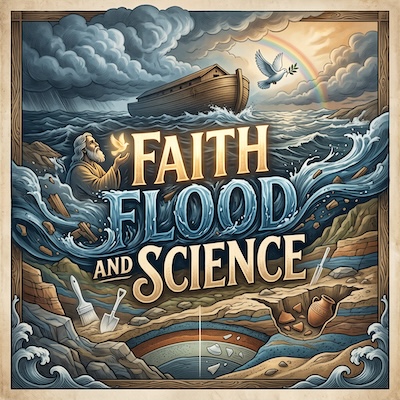
When I was a kid, I wanted to be a geologist when I grew up. I was fascinated by rocks and fossils and seeing proof that my home area, Missouri, was once the floor of an ancient sea. What about Noah and the flood? For generations, believers and truth-seekers have stood before the ancient narrative of Noah and the Great Flood with wonder. We know the sacred cadence of Genesis: an unbroken horizon of water, an ark of deliverance crafted from gopher wood, and the triumphant arc of a covenant rainbow set across cleared skies. It is a cornerstone of biblical theology, teaching us about human frailty, moral accountability, divine sovereignty, and unyielding grace.
Yet alongside our spiritual reverence, a natural, thoughtful inquiry arises: What does the physical earth testify regarding these ancient waters? When we set aside the modern divide between scientific inquiry and heartfelt faith, an incredible story unfolds—one where dirt, stone, and scripture speak together in harmony.
The Spade in the Soil: Searching for Ancient Waters
In the late 1920s and early 1930s, the cradle of civilization—the vast river valleys of southern Mesopotamia—became the focal point of archaeological exploration. Pioneers of biblical archaeology traveled with spades and brushes to see if physical layers of sediment corroborated the biblical account.
In 1929, British archaeologist Sir Leonard Woolley made headlines across the globe while excavating the ancient city of Ur (Tell el-Mukayyar), the biblical hometown of Abraham. Sinking deep shafts beneath the occupational layers, Woolley’s team struck an extraordinary formation: an eight-to-eleven-foot deposit of clean, sterile, water-laid clay. There were no pottery shards, no brick rubble, and no signs of habitation—just silent sediment laid down by an overwhelming deluge.
Subsequent excavations across the region revealed similar dramatic flood horizons:
| Site | Archaeologist | Geological Evidence | Estimated Era |
|---|---|---|---|
| Ur (Tell el-Mukayyar) | Sir Leonard Woolley (1929) | 8–11 feet of pure alluvial clay layer | c. 3500–3100 BCE |
| Kish (Tell al-Uhaymir) | Stephen Langdon & L. Watelin (1928) | Stratified water-borne silt layers | c. 2800–2600 BCE |
| Shuruppak (Tell Fara) | Erich Schmidt (1931) | 2-foot deposit of yellow alluvial sand & clay | c. 2900–2800 BCE |
The Silt of Shuruppak: Where Stone Meets Text
The discovery at Shuruppak proved especially remarkable. In parallel ancient Near Eastern writings, such as the Epic of Gilgamesh and the Atrahasis Epic, the flood survivor is explicitly identified as a nobleman of Shuruppak. When Schmidt excavated the mound, he discovered that a devastating alluvial event had physically wiped the city clean around 2900 BCE, drawing a distinct line between archaic civilizations and the era that followed.
In the low-lying, exceptionally flat alluvial plain of Mesopotamia, overflowing river levees or northern glacial runoff meant water did not merely create puddles—it erased the known world from horizon to horizon. For those who lived through it, reality dissolved into an endless sea.
Beyond the Divide: Analytical Truth Meets Spiritual Reality
Modern culture often presents a false dilemma: choose rigid literalism detached from observable earth sciences, or dismiss sacred scripture as folklore. Yet Scripture reminds us:
“The heavens declare the glory of God; and the firmament sheweth his handywork.” — Psalm 19:1
God’s creation and God’s revelation are not competing voices; they are two sides of the same ledger. When viewed through a mature faith, several realities emerge:
- The Reality of Human Memory: Biblical writers were not inventing fairy tales. Sediments beneath the desert reveal that our spiritual forebears endured cataclysmic, world-altering disruptions forever stamped upon collective memory.
- The Distinctive Spiritual Message: Pagan mythologies claimed gods unleashed floods out of petty annoyance over human noise. Scripture elevates the event to moral and redemptive weight: God’s grief over systemic violence, paired with covenantal mercy toward the righteous to preserve life.
- A Joined Understanding: Science provides the physical mechanics—soil stratigraphy, hydrology, and sediment layers. Faith reveals the Father’s heart—spiritual meaning, moral order, and covenant keeping.
The Eternal Promise Beyond the Waters
Believers have every reason to take courage. The earth does not contradict the work of God; it witnesses to the crucible of real history in which faith was born, tested, and preserved.
When analytical inquiry and deep spiritual conviction walk together, faith is enriched rather than weakened. God meets us directly in the midst of real soil, real waters, and real life storms. Just as He remembered Noah in the heart of the flood, His covenant of mercy remains steadfast for your life today.
Discover more from Fathers Heart Ministry
Subscribe to get the latest posts sent to your email.