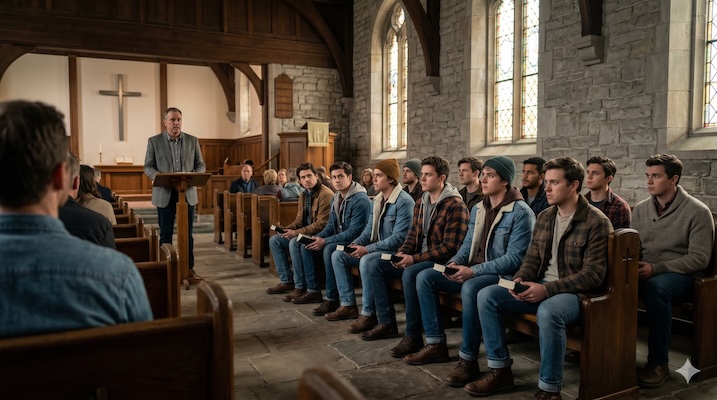
Faith, Authority, and the “Manosphere”: Is the Church’s Appeal to Young Men About Community or Control?
A fascinating—and highly polarized—debate was sparked on The View when Whoopi Goldberg and her co-hosts discussed a notable shift in modern demographics: Gallup data showing an uptick in young men turning to religion.
Instead of viewing this trend as a conventional spiritual revival, Goldberg and co-host Sara Haines linked the phenomenon to the rise of the “manosphere.” The core of the assertion? That certain corners of modern Christian culture are appealing to young men because they offer a traditional, patriarchal blueprint—one where men hold absolute authority and wives are expected to be submissive and obedient.
This provocative claim raises a vital question for our current cultural moment: Are young men flocking to Christianity for genuine spiritual refuge, or are they seeking a socially sanctioned extension of the manosphere?
The Argument for the “Manosphere” Connection
To understand the perspective shared on The View, one has to look at the overlap between traditional religious imagery and the anxieties of the modern young male.
Proponents of Goldberg’s theory argue that today’s secular culture can feel deeply destabilizing for young men navigating shifting gender roles, economic instability, and dating fatigue. In this climate, certain online theological subcultures—often dubbed “The Christ Pill”—explicitly market traditional family structures as the antidote to modern chaos.
From this viewpoint, the church isn’t just offering salvation; it’s offering a clear hierarchy. For a young man feeling disempowered by secular society, a theology that emphasizes male headship and female submission can look less like ancient faith and more like a tool for reclaiming personal control and domestic authority.
The Counter-Argument: A Search for Meaning over Domination
On the other side of the aisle, Christian commentators and sociologists argue that this critique fundamentally misinterprets both the data and Christian theology.
Studies on young men’s motivations consistently show that the online “manosphere” (personified by figures like Andrew Tate) ranks quite low among their day-to-day ideals. Instead, data from organizations such as the Institute for Family Studies suggest that young men are experiencing a profound crisis of isolation, purpose, and economic frustration.
When these men enter a church, defenders argue they are looking for three distinct things that secular spaces often fail to provide:
-
Accountability and Responsibility: Far from wanting a “submissive wife” to dominate, Christian teachings call on men to sacrifice themselves for their families. True biblical headship is modeled on servant leadership, not absolute control.
-
A Blueprint for Adulthood: The church offers concrete, historical benchmarks for life—marriage, parenthood, and community service—in an era where conventional milestones have broken down.
-
Genuine Brotherhood: It provides a physical, real-world community to counter an increasingly lonely, digital existence.
The Core Question: Submissive Wives or Sacrificial Husbands?
Ultimately, this debate highlights a massive disconnect in how modern society views traditional values.
If a young man enters a church seeking a platform to demand a submissive, obedient wife, he is likely to misunderstand the core tenets of historical Christian marriage. In standard Christian theology, any call for a wife’s submission is paired with an equally demanding mandate for the husband: to love his wife sacrificially, putting her needs entirely above his own.
However, it is also true that some fringe movements within religious spaces do weaponize these doctrines, merging political grievances with theology to create a highly rigid, patriarchal worldview that mirrors online reactionary subcultures.
What Do You Think?
Is the church genuinely acting as a healthy sanctuary for young men looking for structure, purpose, and community? Or is the intersection of internet culture and traditional religion creating a new, baptized version of the manosphere?
For a deeper dive into how public figures and religious leaders are reacting to these cultural critiques, you can watch this report on Whoopi Goldberg’s Commentary on Faith Culture, which breaks down the intense public furor and the theological pushback that followed her recent statements regarding religion in America.
Discover more from Fathers Heart Ministry
Subscribe to get the latest posts sent to your email.

Greyson Stoehr says:
I believe the modern “typical church” attitude of men always being in charge of women is ALSO what fires up the current trend of women of FLEEING the churches for things like Wicca and the occult, which are viewed as freeing and without patriarchal dominance. BOTH of these wrong ideas need to be corrected within our churches, but even I, as a female Christian, often suffer in the pews from the wrong attitudes of my fellow male believers inside the sanctuary with me. I’m always have to explain, when witnessing to modern pagans, how the patriarchal attitudes didn’t come from Christ, but from men who get a little responsibility and then learn to use it to control others.