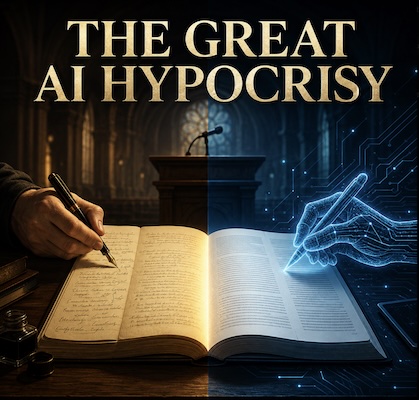
The Great AI Hypocrisy: Human vs. Artificial Assistance
An inside look at the massive contradiction shaping modern Christian publishing.
Have you ever wondered how your favorite pastors manage to preach every Sunday, run global organizations, travel the world, and still publish multiple best-selling books every single year? The truth is, they rarely do it completely alone. In the Christian literary world, turning raw audio sermons and spoken teachings into polished books is a widespread, standard practice. Are you surprised that many well-known ministries use ghostwriters?
While the word “ghostwriter” might make it sound like a hidden secret, the process is actually a highly organized collaboration. Writing a book requires a completely different skill set than delivering an impassioned sermon from a pulpit. To bridge that gap, many of the most influential figures in church history and modern ministry have relied on professional writers, specialized scribes, and editorial teams to bring their spoken messages to the printing press.
A Widespread Tradition: Ministers Who Use Writing Collaborators
When you look at the wider landscape of Christian publishing, the list of major leaders who have utilized uncredited writers or editorial collaborators to transform their audio and notes into books is extensive. It spans across generations and theological movements:
- Oral Roberts: The famous televangelist pioneer published dozens of books. Professional Christian ghostwriters have openly shared that entire projects, such as Roberts’ 1990 book Prayer Cover Over Your Life, were fully written by outside authors transforming his core ideas into print.
- T.D. Jakes: The highly influential bishop utilizes skilled collaborative writers to handle his vast catalog of books, typically requiring strict confidentiality agreements to keep the focus on the ministry’s central voice.
- Billy Graham: Even the world’s most famous evangelist relied heavily on a trusted inner circle. His longtime editorial assistant, Dr. John Corts, alongside other talented writers, spent decades shaping Graham’s spoken messages and extensive notes into cohesive manuscripts.
- Joel Osteen: The Lakewood Church pastor’s best-selling books are heavily developed by taking his highly polished, structurally sound audio sermons and handing them to professional publishing teams to expand into full-length book chapters.
- John C. Maxwell: The global leadership expert and former pastor openly utilizes an extensive team of writers and researchers to compile, structure, and edit his massive library of seminars and spoken lessons.
- Pat Robertson & D. James Kennedy: Investigative reports from major news outlets have highlighted both of these massive radio and television ministers as prominent examples of leaders whose books were entirely crafted by background writers.
- Bill Hybels: The megachurch founder relied closely on collaborative editors to systematically turn his practical, audio-recorded weekend church-leadership sermons into retail books.
- David Wilkerson & Corrie ten Boom: Even classic, deeply personal narratives like The Cross and the Switchblade and The Hiding Place relied on professional “as-told-to” writers to shape raw audio tapes, interviews, and spoken testimonies into gripping literature.
The Word of Faith and Prophetic Machine
This process is especially vital in modern spiritual movements like Word of Faith and the Prophetic movement, where content must move at lightning speed.
In the Word of Faith movement, leaders like Kenneth Copeland oversee massive media networks. Kenneth Copeland Ministries (KCM) actually employs an internal writing department—publicly referred to as the “Pen of a Ready Writer” team. These staff writers do not invent new theology; instead, they spend hundreds of hours listening to Copeland’s recorded television broadcasts, tapes, and sermon audio. They pull out the core teachings, organize the scripture references, and format them into the daily devotionals and books millions of people read. Longtime writers for the ministry have openly shared how rewarding it is to immerse themselves in the audio teachings to perfectly mimic the pastor’s voice on the page.
Meanwhile, the Prophetic movement moves even faster. Because prophetic ministers are expected to deliver a timely “fresh word” or a blueprint for a specific year, they use specialized editors to quickly transcribe prophetic audio utterances or conference declarations. These “prophetic scribes” quickly clean up the spoken repetition and publish a book before the season passes.
The Power Houses: Publishers Who Manage the Process
How do these raw audio files actually make the leap to major retail shelves? That is where specialized Christian publishing houses come in. These publishers do not just print the final files. They act as project managers who match a minister’s audio catalog with the right writing team.
Destiny Image
Known as a cornerstone publisher for the Charismatic and Prophetic movements, Destiny Image excels at moving quickly. They often work with specialized developmental editors who know how to take spontaneous conference prayers, audio prophecies, or supernatural teachings and structure them into powerful thematic books.
Charisma House
This powerhouse publisher deeply understands the vocabulary of spiritual warfare, the prophetic, and Charismatic culture. They frequently connect authors with specialized collaborative editors who ensure that the raw excitement of an audio sermon is not lost when translated into standard paragraphs.
Thomas Nelson & Zondervan (HarperCollins)
At the corporate end of Christian publishing, major imprints such as Thomas Nelson and Zondervan bring extensive editorial, research, marketing, and production resources to a project. A prominent minister may supply the core message, sermon archive, interviews, and personal stories, while a coordinated team helps shape those materials into a market-ready manuscript. By the time the book reaches readers, many hands may have contributed to its structure, clarity, tone, and presentation.
Enter Artificial Intelligence
Artificial intelligence has now entered this long-established production chain. A minister can provide a sermon transcript, a collection of notes, or hours of recorded teaching and use an AI tool to organize themes, suggest chapter outlines, improve transitions, summarize repeated ideas, or help adapt spoken language for the printed page.
In practical terms, some of these tasks resemble work that human assistants, transcriptionists, researchers, editors, and ghostwriters have performed for decades. The technology may be new, but the underlying question is not: How much assistance can an author receive before readers deserve a clearer explanation of how the work was produced?
If a human collaborator may organize a minister’s sermons, refine the language, and shape the material into a book, what makes comparable assistance from software fundamentally different—and where should the ethical line be drawn?
The Real Questions: Ownership, Accuracy, and Transparency
The debate becomes more useful when it moves beyond a simple contest between “human” and “artificial.” Every form of collaboration raises questions that deserve serious consideration:
These standards can be applied to a staff writer, an outside ghostwriter, a professional editor, or an AI system. Human collaborators can introduce errors or reshape a message too aggressively. AI can do the same, including producing confident statements that are inaccurate. In either case, responsible publication still requires careful review, discernment, and ownership by the person whose name appears on the cover.
A Double Standard—or a Meaningful Distinction?
Supporters of AI-assisted writing may argue that the tool is simply the latest addition to an already collaborative industry. Critics may respond that AI differs from a human editor because its training, sourcing, reliability, and influence on the finished language can be difficult to see. Both positions raise legitimate issues.
The contradiction appears when one form of extensive assistance is treated as normal and professional while another is condemned automatically, without asking what the tool actually did. A spelling correction is not the same as inventing a testimony. Organizing a transcript is not the same as generating a theology. Suggesting an outline is not the same as replacing the author’s judgment. Ethical evaluation requires more detail than the label “AI-generated.”
At the same time, the long history of human ghostwriting does not settle every concern about artificial intelligence. A familiar practice is not necessarily a flawless one, and a new technology should not be exempt from scrutiny merely because older forms of assistance were accepted. The more meaningful standard is whether the finished work faithfully represents the named author’s message and whether the process honors the trust of the reader.
The Conversation Christian Publishing Must Have
Christian publishing has never been a solitary enterprise. Sermons become transcripts. Transcripts become outlines. Editors strengthen arguments. Researchers verify details. Designers, marketers, and publishers prepare the message for an audience. Artificial intelligence now stands alongside those established tools and collaborators, forcing the industry to examine assumptions that were easier to ignore before.
The central issue is not simply whether assistance was used. It is how that assistance was used, who supplied the substance, who verified the result, who accepts responsibility for it, and what readers reasonably deserve to know.
Is AI assistance fundamentally different from human collaboration, or has new technology merely exposed an old and uncomfortable inconsistency? That is a question every author, publisher, ministry, and reader must decide.
I’d like your thoughts on this. Email me at:
russellwalden@gmail.com
Discover more from Fathers Heart Ministry
Subscribe to get the latest posts sent to your email.