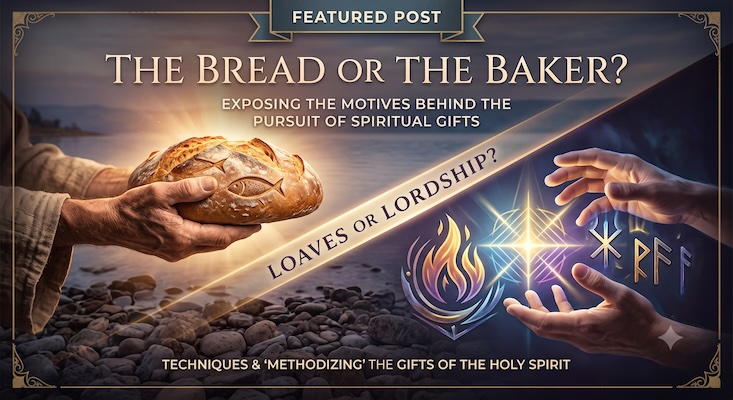
This post begins with a brief narrative reimagining of a specific scene from John 6. Rather than retelling the entire miracle of feeding the 5,000, this scene focuses narrowly on the day after—when the crowd tracked Jesus down across the lake. This creative vignette serves as a lens to explore a deeper theological question: Is it possible that our modern desire for spiritual power and gifts stems from the same compromise as the crowd’s request for food?
“The morning sun reflected off the gentle ripples of the Sea of Galilee as the crowd dusted off their tunics. Yesterday, thousands had sat on the grassy hillside, mesmerized as bread and fish multiplied endlessly from a boy’s meager lunch. Today, their stomachs were rumbling again.
They had rowed across the lake to Capernaum, desperate to find the miracle worker. When they finally found Him standing near the shore, they didn’t ask Him for His wisdom or His call to repentance. Instead, after Jesus called out their true desire—that they merely wanted another free meal—they asked a revealing question:
“What must we do, so that we may work the works of God?”
Beneath the surface of that request lay a quiet motive: “Give us the formula so we don’t have to keep chasing You for bread.”
The Subtle Desire for Independence
When the crowd in John 6 asked Jesus how they could perform God’s works themselves, it seemed like a pious inquiry. They weren’t asking to break God’s law; they were asking for divine power. But Jesus saw right through it. They had tasted the bread, enjoyed the supernatural provision, and immediately wanted to master the mechanism behind it.
If they knew how to do the works of God, they would no longer need to remain dependent on Jesus. They could secure their own miracles, control their own supply, and retain authority over their own lives. They wanted the benefits of the Kingdom without the surrender to the King.
“Jesus answered them, ‘Very truly I tell you, you are looking for me, not because you saw the signs I performed, but because you ate the loaves and filled your bellies… The work of God is this: to believe in the one he has sent.'”
— John 6:26, 29
The Parallel: Modern “Gifts” vs. Abiding Relationship
This ancient interaction raises an uncomfortable question for the contemporary Church: Could some of our modern enthusiasm for spiritual gifts, power ministry, and “supernatural activation” courses stem from the exact same compromised motive?
Across various movements today, immense energy is poured into teaching believers how to move in the gifts of the Spirit—how to prophesy, heal, or operate in signs and wonders. While desiring spiritual gifts is explicitly biblical (1 Corinthians 14:1), a subtle drift often occurs when the focus shifts from abiding in Christ to mastering a spiritual technology.
Simon Magus and the Trap of “Spiritual Capability”
This compromise is not new. In Acts 8, we encounter Simon the Sorcerer, who observed the apostles laying hands on believers to impart the Holy Spirit. Astounded by the tangible authority, Simon offered money to purchase the capability: “Give me also this ability so that everyone on whom I lay my hands may receive the Holy Spirit” (Acts 8:19).
Peter’s rebuke was fierce because Simon viewed the Holy Spirit as a commodity—a tool to enhance his own influence. When spiritual gifts are taught as repeatable skills or step-by-step formulas, we risk reducing the sovereign Holy Spirit to an energy source that can be harnessed through the right method.
- Compromised Motive: Seeking power, activation, or spiritual gifts to gain control, feel spiritual validation, or avoid the vulnerability of ongoing daily dependence on God.
- Pure Motive: Desiring gifts out of deep love for Christ and others, recognizing that gifts are sovereignly distributed by the Spirit (1 Cor 12:11) for building up the body of Christ.
Conclusion & Practical Application
Recognizing this potential compromise does not mean we should abandon the pursuit of spiritual gifts. Scripture encourages us to eagerly desire them. However, it requires us to relentlessly examine our hearts regarding why we seek them.
When Jesus responded to the crowd, He didn’t hand them a multi-step blueprint for performing miracles. He pointed them back to faith and union with Himself: “The work of God is this: to believe in the one he has sent.” Spiritual authority is never an independent skill set; it is the overflow of abiding in the Vineyard owner.
To be clear: this perspective is not an argument against spiritual gifts or ministry training. Rather, it serves as a heart check for spiritual practice. The danger isn’t in desiring the works of God, but in wanting the bread without yielding to the Bread of Life. True spiritual authority comes from abiding submission, not procedural mastery.
Discover more from Fathers Heart Ministry
Subscribe to get the latest posts sent to your email.