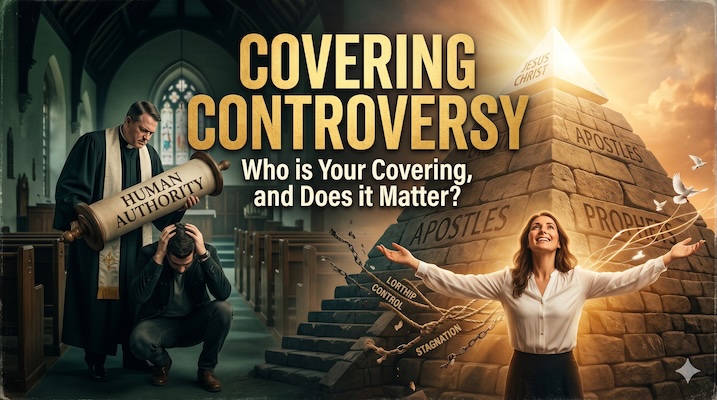
This word on the issue of spiritual leadership and covering is long overdue in the body of Christ.
-
For Ministry Leaders: This message will inform and empower you to see results with difficult people like nothing else will.
-
For Those with Unsaved Loved Ones: This message will give you traction in your prayer life to see hearts change and lives transformed.
-
For the Spiritually Bruised: If you have experienced the abuse of heavy-handed leadership, this message will set you free and empower you to move into your calling without shame or hesitation.
We absolutely need leadership and accountability in the Kingdom. What we don’t need are leadership tactics that suppress your calling, stifle your spirit, and hold you bound in stagnation and abuse under egotistical, strutting little Napoleons masquerading as “the covering” that you must submit to “or else!”
Many will disagree with what is said here. Leaders will object that strong, top-down leadership is necessary. People who have drunk the Kool-Aid of dictatorial leadership will be repelled because this message makes them responsible for what they have surrendered to human authority. But for everyone else in the middle, you are about to take a long-needed breath of fresh air.
In Luke 22:24-26, Jesus chastised His followers for adopting worldly concepts of authority:
“And there was also a strife among them, which of them should be accounted the greatest. And he said unto them, The kings of the Gentiles exercise lordship over them; and they that exercise authority upon them are called benefactors. But ye shall not be so: but he that is greatest among you, let him be as the younger; and he that is chief, as he that doth serve.”
In the world, leadership structure is top-down and hierarchical. Jesus plainly states that leadership in the Kingdom does not work that way. Paul makes God’s “upside-down” order obvious in Ephesians 2:20:
“…and are built upon the foundation of the apostles and prophets, Jesus Christ himself being the chief corner stone;”
Let me ask a question: How can a leader be on top and in the foundation all at the same time? He cannot. Leadership in the Body of Christ is undeniably structured by Biblical mandate to be undergirding, not overbearing.
       ▲ [Jesus: The Capstone]
      / \
     /   \  [The Believers: Lively Stones]
    /_____\
   [Apostles / Prophets: The Undergirding Foundation]
This Kingdom infrastructure is indeed a pyramid, but it is inverted from the world’s model. The leadership undergirds the believer, with Jesus Christ acting as the singular capstone at the structure’s apex. Unfortunately, modern Christian culture has pervasively adopted the worldly, mirror-opposite model of leadership.
The Upside-Down Leadership of the Kingdom
Watchman Nee, the apostolic father of the modern church in China, faced this exact dilemma. He sent out workers ordained as pastors, elders, and deacons. After ten years, he took inventory and found that these leaders had become title-conscious, overbearing, competitive, and dictatorial. To correct this, Nee laid aside all titles and simply called the leaders “responsible brethren.” (Note: I am not advocating for the removal of titles altogether).
When I first read this, it sparked a massive shift in my thinking. The Lord told me to substitute the word “authority” for “responsibility.” Instead of trying to determine who in my sphere of ministry was responsible to me, I began to ask the Father who I was responsible to Him for.
Kingdom leadership is not about who answers to you. Nor is it about letting people think you are responsible to them. The people do not answer to me, and I do not answer to them. We all answer to the Father.
Consider the prophetic picture of the pyramid: Jewish mystics believed that the Great Pyramid was built as the “testimony in Egypt” spoken of in Isaiah 19:19-20. It was the only pyramid built without a top—a physical prophecy that the Messiah would come as the singular capstone of the corporate, many-membered temple of God. Apostles and prophets undergird from the foundation, while the “lively stones” (1 Peter 2:5) are covered strictly by the Capstone, Jesus Christ (Zechariah 4:7).
The Covering Error
How can a leader see themselves as a “covering headship” over the people they serve if they are supposed to be in the foundation? In Luke 22:25, Jesus plainly stated “it shall not be so” that we lord authority over God’s heritage.
Does this mean believers don’t need headship? No. But scripture is explicit about who that head is:
“But I would have you know, that the head of every man is Christ…” — 1 Corinthians 11:3
A pastor, prophet, or apostle is not your head. Jesus is. Some argue this verse applies only to the nuclear family, but the very next verse solidifies it in a corporate, ministerial setting:
“Every man praying or prophesying, having his head covered, dishonoureth his head.” — 1 Corinthians 11:4
If Christ is your head, then treating a human leader as your ultimate spiritual covering actually dishonors Him. Because we have adopted carnal concepts of leadership, we have wrongly claimed an authority over the people of God that Jesus never authorized.
In Genesis 4:9, God asked Cain, “Where is Abel thy brother?” Cain dismissively responded, “Am I my brother’s keeper?” The implied scriptural answer is a resounding yes. You answer to the Father for your brother. You have a potent, prayerful influence over those whom God has placed within your “measure.”
“But we will not boast of things without our measure, but according to the measure of the rule which God hath distributed to us, a measure to reach even unto you.” — 2 Corinthians 10:13
Your Spheres of Accountability
-
Yourself: Every man and woman answers directly to God for their own actions.
-
Your Family: You are accountable for your spouse and your children.
-
Natural Authority: Positions like supervisor, manager, or teacher.
-
Spiritual Family: The people you teach, lead, guide, or counsel.
When you go before the Father, ask Him: “Who am I accountable for? Who do I answer to You for—not just for my conduct, but for their conduct and the outcome of their decisions?”
You may come up with a surprising list. It will include those who attend your meetings, but it may also include people who do not respect you or want anything to do with you. There are distinct levels of accountability; teachers do not bear the same weight as spiritual fathers.
The Function of Leadership from a Biblical Paradigm
Your spiritual children are those who carry your spiritual DNA. For those few, you bear a much heavier responsibility than you do for a peer or a distant constituent. How do you properly discharge this responsibility? The secret is found in a powerful, often misunderstood verse:
“Obey them that have the rule over you, and submit yourselves: for they watch for your souls, as they that must give account, that they may do it with joy, and not with grief: for that is unprofitable for you.” — Hebrews 13:17
In the original Greek, the word “watch” literally means “to be sleepless over.”
When you lie awake at night, whose faces come to mind? Who do you lose sleep over? Those are the individuals the Father is holding you responsible for.
Hebrews 13:17 is a direct instruction on how to handle that responsibility. As leaders, we are expected to go before the Father and give an “oral report” (an accounting term, like testifying before a government oversight committee) for those in our care.
| If You Give an Account With… | The Result for the Constituent Is… |
| JOY | It unleashes divine blessing upon every area of their life. |
| GRIEF | It becomes unprofitable (pernicious — tending to cause serious harm or injury). |
When you tell the Father, “I am not happy to answer for what I see in that person’s life,” you aren’t dictating terms to God. You are simply reporting in. You are asking the Father to go to work in their hearts to give them a willing heart and a hearing ear for what you are responsible to say to them.
How to Give an Account
There is no use in trying to force people into accountability. They must do it willingly because Christ—their true Head—requires it of them. Your job is to give a regular account in prayer. As you do, the Father will work behind the scenes, making them teachable until their lives reflect something you can report on joyfully.
Remarkably, this principle also applies when people level false blame or project guilt onto you. When people blame you, they are inadvertently making you a “responsible brother.” They are granting you a position of spiritual authority over them in that situation. Until they walk in forgiveness and drop their offenses, you hold the spiritual ground. This is why Jesus warned that unforgiveness turns a person over to the “tormentors.”
When you are spoken evil of or held responsible for things you didn’t do, do not feel powerless. Rejoice! Your critics have inadvertently handed you spiritual leverage in the situation, much like God made Moses a “god” to Pharaoh (Exodus 7:1). Just ensure that you operate strictly in the spirit of love, or you will find yourself in harm’s way before the Father.
Conclusion
This message is a path of progress to help you find traction when dealing with difficult spouses, children, home group members, or fellow ministers. When we shift from trying to control people to giving an account for them before the Father, circumstances change, people transform, and our joy increases.
This transformation often involves a transition period—a time of turbulence that provokes people to finally come to us for the wisdom the Father has prepared us to give them.
For those who have been abused and ridden over roughshod by heavy-handed Christian leaders:
Forgive them. Forgive them and walk away from those dysfunctional situations. It is time to grow up and grow on in God. Forgive, release, and bless. Give an account for them to God, set yourself free by relinquishing your offenses, and refuse to allow anyone to exercise lordship over God’s heritage—which you rightfully are.
Discover more from Fathers Heart Ministry
Subscribe to get the latest posts sent to your email.