History has a haunting way of repeating itself. In the final days of the kingdom of Judah, the prophet Jeremiah stood amidst a collapsing society during a time of moral decay and spiritual declension unprecedented in Israel’s history. He witnessed the transition from the golden reformation of King Josiah to the wretchedness of the four kings who followed. It was a time of political upheaval, with eleven invasions from superpowers like Egypt and Babylon.
But the greatest tragedy wasn’t the external threat—it was the internal apathy.
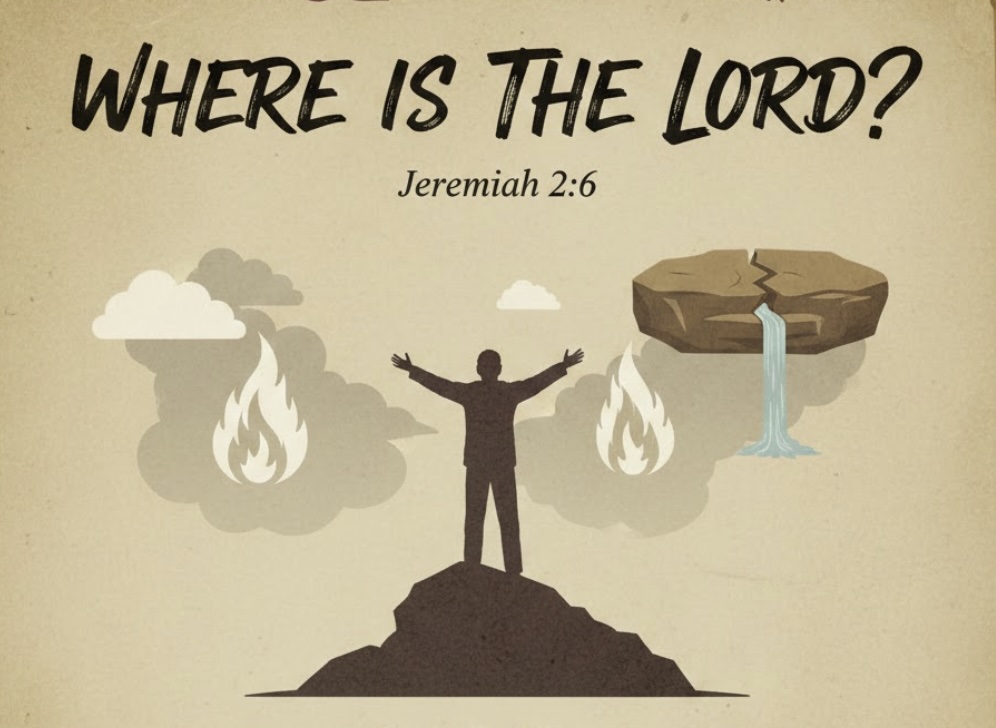
In Jeremiah 2:6, the prophet records a grievance from the heart of God that should shake us to our core today:
“Neither said they, Where is the LORD that brought us up out of the land of Egypt, that led us through the wilderness, through a land of deserts and of pits…?”
God was marveling at a terrifying reality: His people had stopped missing Him. They no longer questioned the absence of the miraculous. They saw the drought, the pits, and the shadow of death, yet they never stopped to ask, “Where is the God of the Red Sea? Where is the God of the Manna and the Water from the Rock?”
The Sophisticated Silence of Modernity
In my 40-plus years of ministry, I have watched a dangerous “new maturity” sweep through the Church. We have respected leaders—men with household names—who mock the “revival paradigm.” They treat the expectation of Christ’s return or the desire for a move of God as an immature phase that “grown-up” Christians should outgrow.
These pseudo-sophisticated voices, the mega-church strategists, and the armchair heresy hunters have shamed the hungry into silence. They claim that seeking signs and wonders is “not cutting edge” or “theologically irrelevant.”
But I ask you: Is this maturity, or is it the same spiritual blindness that preceded the 400 years of silence?
Jesus asked, “When the Son of Man comes, will he find faith on the earth?” He wasn’t asking whether He would find church attendance, correct systematic theology, church as entertainment, or baristas in the gathering area; He was asking whether He would find a people expecting His hand to move.
The Prophetic Bridge
After Jeremiah, the voice of the prophet soon went silent for four centuries. No miracles, no “Thus saith the Lord.” Then came John the Baptist.
Scripture says “John did no miracle,” yet Jesus said no man born of woman was greater than he. Why? Because the prophetic office—even when devoid of immediate miracles—is the engine God uses to inaugurate a new season of power. John was the “wheat” in a desert of “chaff,” sent to prepare the way for the greatest explosion of signs and wonders in human history.
Today, many say, “Those days are over.” We see the prophetic movement in utter shambles—full of people who went but were not sent, and voices speaking from their own imaginations. But we must look at Jeremiah 23:28:
“The prophet that hath a dream, let him tell a dream; and he that hath my word, let him speak my word faithfully. What is the chaff to the wheat? saith the LORD.”
God acknowledges the chaff, but He commands us not to throw out the wheat! Just as John the Baptist ushered in the ministry of Jesus, God is using authentic prophetic voices today to prepare us for a return of signs, miracles, and wonders so great that we won’t have to look back at “the old days”—we will be living in them.
The Altar vs. The Ballot Box
In Jeremiah’s day, the kings didn’t look to God; they looked to Egypt (representing the world system), Assyria (the anti-Christ spirit), and Ethiopia (stubborn ways of carnality). They looked for political alliances to save them, only to find that those nations were simply waiting to spoil them.
In the last 50 years, the American Church has largely abandoned the prayer closet for the voting booth. We have tried to raise up “Sauls”—leaders who stand head and shoulders above the rest—hoping politics will be our savior.
Politics cannot save us. Is there not a God in heaven? Is prayer of no effect in 2026? It is time to stop being “super-saints” who are too sophisticated for the supernatural. It is time to start asking the question Jeremiah’s generation refused to ask: “Where is the Lord?”
If we stop settling for the “silent era” of dry religion and start hungering for His manifest presence, we will see the hand of God sweep through our land once again.
Conclusion
To help us move from passive observation to active spiritual inventory, here is a set of reflective questions based on the themes of Jeremiah’s era and the “silent years”:
The Heart of Expectation
-
Am I missing God? If the “miraculous” (God’s direct intervention) were absent from my life or my church for the next year, would I truly notice, or have I become comfortable with a God-theory rather than a God-reality?
-
The “Where is God?” Question: When I face a “desert” or a “pit” (as mentioned in Jeremiah 2:6), is my first instinct to look for a political, financial, or psychological solution, or do I stop to ask, “Where is the Lord who brought me out of my past bondages?”
-
Revival or Religion? Have I allowed “sophisticated” teaching to talk me out of my hunger for a move of God? Do I view the desire for signs and wonders as “immature,” or as a biblical birthright?
Identifying False Alliances
-
My Modern Egypt: What “worldly system” am I currently leaning on for my security? (e.g., my career, my bank account, my social standing).
-
The Voting Booth vs. The Prayer Closet: Has my passion for political outcomes eclipsed my passion for spiritual breakthroughs? Do I spend more time debating the “kings of the earth” than I do petitioning the King of Heaven?
-
The “Ethiopian” Nature: Is there an area of my life where I have said, “I can’t change; this is just my spots/my skin,” instead of bringing that “unchangeable” nature to the prophetic word of God for transformation?
The Prophetic and the Miraculous
-
Wheat vs. Chaff: Am I so afraid of the “chaff” (false prophets/shambled ministries) that I have completely closed my heart to the “wheat” (the genuine voice of God)?
-
The “John the Baptist” Role: Am I willing to be a voice crying in the wilderness—preparing the way for Jesus to move—even if I don’t see the full manifestation of the miracles in my own hands immediately?
-
Personal Doctrine vs. Personal Need: If I say I don’t “believe” in the gifts of the Spirit or divine healing today, is that based on a deep study of Scripture, or is it a defense mechanism to avoid the disappointment of not seeing them manifest yet?
Taking Action
-
Breaking the Silence: What is one “bold ask” I can bring before God today that requires His supernatural hand and cannot be solved by human effort?
-
Returning to the First King: Josiah’s reign was marked by rediscovering the Word of God in the temple. Have I neglected the “Book” while trying to navigate the “Invasions” of my life?
A Prayer for the Breaking of Silence
Heavenly Father,
We come before You today with hearts that refuse to be satisfied with mere form and ceremony. We thank You for the legacy of the “Josiahs” who have gone before us, but we confess that, like the generations after him, we have often looked to Egypt for our strength and Assyria for our security. We have traded the prayer closet for the platforms of men, and we have allowed the “chaff” of false voices to make us cynical toward the “wheat” of Your true Word.
Lord, forgive us for the sin of no longer asking, “Where is the LORD?” Forgive us for becoming so sophisticated that we no longer tremble at Your power or expect Your hand to move in our streets. We refuse to settle for a “silent era.” We refuse to be shamed into a faith that has no fire.
Right now, we lift up our eyes beyond the political fray and the crumbling systems of this world. We ask for the John the Baptist anointing—the prophetic voice that prepares the way for the miraculous. We pray that You would stir the embers of revival in our hearts once again. Break the spirit of apathy that accepts the absence of Your glory as “normal.”
Lord, manifest Your signs, wonders, and miracles in our day, not for our fame, but for Your name’s sake. Let the world see that there is still a God in Israel who delivers from the pit and leads His people through the wilderness.
We choose to be the wheat. We choose to be the expectant. We choose to look for Your return and Your power with unashamed faith.
In the mighty name of Jesus, Amen.
Discover more from Fathers Heart Ministry
Subscribe to get the latest posts sent to your email.