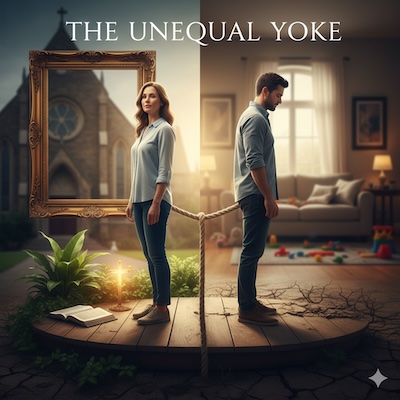
The Unequal Yoke: Are We Fighting the Right Marriage Battles?
Many of the most intense debates in the modern church circle back to one issue: same-sex marriage. You can’t scroll through social media, attend a meeting, or even have a casual conversation with a fellow believer without the topic arising.
For those who hold to a traditional reading of scripture, the objections to same-sex marriage are clear, and they are rooted in the Bible.
The Biblical Case Against Same-Sex Marriage
Proponents of the traditional view frequently cite foundational verses and passages, including:
- Genesis 1:27 & 2:24: The creation account establishing marriage as between a man and a woman, for the purpose of “leaving and cleaving” and procreation.
- Leviticus 18:22 & 20:13: Clear prohibitions against same-sex relations in the Old Testament law.
- Romans 1:26-27: Paul’s discussion of dishonorable passions and unnatural relations as a sign of spiritual rebellion.
- 1 Corinthians 6:9-10 & 1 Timothy 1:9-10: Lists of sins that include terms widely interpreted as referring to male homosexual acts.
These scriptures, taken at face value within the context of Christian tradition, form a biblically valid objection to same-sex marriage. For countless devout Christians, this is the end of the discussion.
The Elephant in the Sanctuary: The Unequal Yoke
But we must pause and ask a hard question of ourselves: Is our outrage over one type of marriage a distraction from the compromises we tolerate—and even celebrate—within our own faith community?
The Bible has equally strong, unambiguous warnings against another form of “unholy” union: the unequal yoke.
“Do not be unequally yoked with unbelievers. For what partnership has righteousness with lawlessness? Or what fellowship has light with darkness?” (2 Corinthians 6:14)
This verse is often used to warn believers against business partnerships or deep friendships with non-Christians, but its most profound and historically applied meaning relates to marriage.
The Reality of Modern Christian Marriage
Walk into almost any church today and you will find marriages where one spouse is a committed, vibrant believer, and the other is:
- An active unbeliever (no faith, atheist, or agnostic).
- A nominal Christian (attends only on major holidays, faith plays no real role in daily life).
- A person of a significantly different, non-Christian faith.
When a devout Christian marries an unbeliever, particularly when a wife is the believer and the husband is not, the household dynamics are often the opposite of the Biblical ideal:
- The Woman Becomes the Spiritual Leader: She is the one praying over meals, teaching the children scripture, and driving the family to church.
- The Man is Positionally Reduced: While he may be a loving husband, he is often relegated to the spiritual position of an elder child or a passive attendee—not the spiritual head, shepherd, or priest of his home that many traditionalists insist upon.
- Spiritual Division: The deepest, most foundational aspect of their lives—their faith—remains a source of distance rather than unity.
The Problem of Hypocrisy
This brings us to the core of the issue:
Our vigorous, non-negotiable insistence on a Biblical definition of marriage (man/woman) coexists with a profound soft-pedaling and silent tolerance for a different, equally clear Biblical prohibition (believer/unbeliever).
The objection to same-sex marriage, while Biblically valid on paper, feels disingenuous at best, and hypocritical at worst. It appears we are willing to wage war on the issue that makes us look most righteous to the outside world, while ignoring the issue that hits closest to home.
A Challenge for the Church
Before we quote Romans 1 to a world that isn’t listening, let us consider 2 Corinthians 6:14 for ourselves.
The Call to Action:
- Self-Examination: Are you in an unequal yoke? How are you actively seeking to shepherd your spouse toward the Lord, or are you passively accepting the spiritual division?
- Humble Dialogue: Begin by acknowledging the pain and hypocrisy others see in the Church’s stance. Talk less about their sin and more about the sins of compromise we allow in our own homes.
- Prioritize Discipleship: Let us put the same energy into discipling our married couples against the dangers of the unequal yoke as we do into debates not relevant to our own compromises. Holiness begins at home.
Let the Church be a people known less for what we are against, and more for the profound, unified, and Spirit-led quality of the marriages we do celebrate.
Discover more from Fathers Heart Ministry
Subscribe to get the latest posts sent to your email.