The Gospel of Matthew: The Foundation: Jesus Christ, The Fulfillment:
The Gospel of Matthew stands as the massive, foundational charter of Christianity, the very first book in the New Testament. This position reflects an authority it has held for nearly two millennia. From its very opening line, the author anchors Jesus Christ to the grand sweep of salvation history, instantly connecting him to Jewish royalty and the covenants of old. This theological move is a powerful statement, proclaiming Jesus’s legitimacy not as a sudden anomaly, but as the anticipated climax of God’s plan.
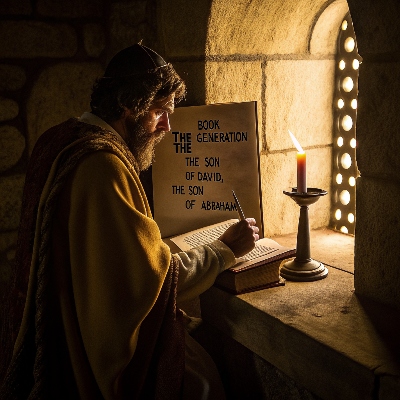
“The book of the generation of Jesus Christ, the son of David, the son of Abraham.” (Matthew 1:1, KJV)
This opening verse is not merely a genealogical record; it is a theological declaration. By immediately linking Jesus to David (the promise of a kingly throne) and Abraham (the promise of a covenant and a great nation), Matthew establishes Jesus as the royal and covenantal heir, the one in whom the entire history of Israel finds its ultimate meaning and fulfillment.
🏛️ Jesus: The New Moses and The Law-Giver
The genius of Matthew’s composition lies not just in its content, but in its deep, intentional structure. The entire Gospel is organized around five major discourses—five massive blocks of Jesus’s teachings, from the Sermon on the Mount to the final discourse on the end times. This is no accident. The author deliberately structured the text to mirror the five books of the Torah (the Pentateuch). This powerful parallel presents Jesus as the New Moses, the supreme and authoritative law-giver who has come not to abolish the Law, but to bring it to its intended, spiritual completion. His teachings are the new standard for the people of God.
“Think not that I am come to destroy the law, or the prophets: I am not come to destroy, but to fulfil.” (Matthew 5:17, KJV)
In this declaration, Jesus confirms his authority as the one who brings the divine Law to its true purpose. Just as Moses delivered the Law at Sinai, Jesus delivers his authoritative interpretation and application across the five teaching blocks. His fulfillment is not mere obedience, but a profound and complete realization of God’s redemptive and ethical will, establishing Him as the ultimate, authoritative guide for the new community of faith.
🧭 The Community and the Cornerstone of Authority
Matthew’s Gospel consistently shapes its narrative to focus on the structure and growth of the nascent Christian community, the Church. The disciples are not portrayed as hopelessly dense, but as people of “little faith” (oligo-pistoi), capable of growth and learning. This subtle shift fits the Gospel’s focus on community leadership and the potential for spiritual maturity. This vision climaxes in the well-known passage where Jesus blesses Peter, calling him the rock and giving him the keys of the kingdom. This unique Matthew addition functions as a foundational charter, establishing clear, divinely sanctioned leadership within the early Church. It provides the necessary authority for a community defining itself amid intense debate.
“And I say also unto thee, That thou art Peter, and upon this rock I will build my church; and the gates of hell shall not prevail against it.” (Matthew 16:18, KJV)
This passage directly authorizes the establishment and endurance of the Church as the new entity of God’s people. The promise that the “gates of hell” (or Hades) will not prevail assures the community of its divine protection and ultimate victory. The authority granted to Peter, the “rock,” became the basis for the organized life and leadership structure that the community, likely facing external pressures, desperately needed to govern itself and transmit the teachings of Christ.
🌍 The Universal Scope: A World-Changing Vision
While the core of Matthew is deeply rooted in Jewish tradition—obsessed with the Law and the fulfillment of prophecy—its ultimate purpose transcends any narrow, localized dispute. The Gospel reflects an initial struggle to define who the “true Israel” is following the destruction of the Temple, yet it does not end there. After the entire narrative is focused on this internal Jewish debate, the story culminates in a dramatic shift, a final, universal mission. Jesus’s very last command transforms the community from one faction within Judaism into a worldwide movement. The final vision for this community is to make disciples of all nations, Gentiles included. This Great Commission reveals the author’s ultimate, world-changing vision.
“Go ye therefore, and teach all nations, baptizing them in the name of the Father, and of the Son, and of the Holy Ghost: Teaching them to observe all things whatsoever I have commanded you: and, lo, I am with you alway, even unto the end of the world. Amen.” (Matthew 28:19–20, KJV)
This concluding passage serves as the ultimate mandate and promise of the Gospel. The command to “teach all nations” explodes the previous, inward focus and establishes a new, boundary-breaking identity for the Church. Furthermore, the accompanying promise, “lo, I am with you alway, even unto the end of the world,” provides the authority and presence of Christ to sustain this global endeavor, confirming that the new community’s authority and mission are not limited, but eternal and universal in scope.
Reflection and Review
The Gospel of Matthew is a masterful, multi-layered work. It presents Jesus as the New Moses who fully embodies and fulfills the Law, thereby establishing His own authoritative teachings as the foundation for God’s people. The text functions as a comprehensive catechism, providing a clear identity and a necessary leadership structure for the early Church. Its genius lies in its ability to simultaneously be the most Jewish Gospel, deeply rooted in the past, yet conclude with the most universal vision, commissioning the Church to the ends of the earth. The structure itself is a powerful theological statement, revealing Jesus as the Messiah whose scope of salvation reaches beyond every national or historical boundary.
Review
- Study the Discourses: Commit to reading and meditating on Matthew’s five great teaching blocks to grasp Jesus’s full authority as the New Law-Giver.
- Embrace the Fulfilment: Identify areas in your life where you attempt to live by the letter of the law and instead seek the deeper, fulfilling spiritual intent revealed by Christ.
- Acknowledge the Cornerstone: Pray for the leaders in your own church community, recognizing the God-given authority required for order and growth.
- Live the Great Commission: Reflect on how your life and actions can reflect the worldwide, disciple-making mandate given by Jesus to all nations.
- Trust the Promise: Reaffirm your faith in Christ’s promise to be “alway, even unto the end of the world,” resting in His enduring presence.
Discover more from Fathers Heart Ministry
Subscribe to get the latest posts sent to your email.