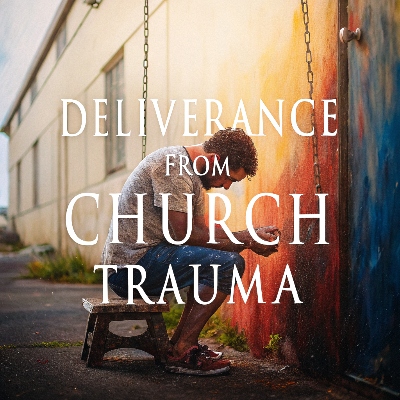
Deliverance from the Tyranny of Church Trauma: In John 15.4 Jesus calls us to “abide in the vine” and makes the observation that if we DON’T abide in the vine MEN will gather us and cast us into the fire (John 15:6). This is not talking about end-time judgment but about the fact that if we look to man (personalities, styles of ministry, worship, etc.) we are in danger of finding the gravitation we feel toward men and ministry to be greater than that which draws us to God and sets us in His purposes as expressed in the many membered body of Christ – and then the probablity of getting used, hurt, disappointed goes up exponentially.
In other words, we get hurt, and we get hurt again, and we check out of the corporate body of Christ. Let me help you with this. We can’t just jettison all truth in God’s word that references the many-membered body of Christ and the call of God for believers to walk out their relationship with Him in connection, cooperation, and community with other believers. Your church trauma does not authenticate the right to opt out of the body of Christ or the Father’s corporate purposes expressed in a local body.
In the book of Isaiah we find a passage that predicts a church-wide descent into rank populism that results in God’s people as a whole struggling with their identity and the contradictions to God’s promises in their lives that arise from a chosen lifestyle and philosophy of “go-it-alone” that frankly are not aligned with or in harmony with Christian life or church life as it is reflected in the book of Acts, the pastoral and general episltes or even the teachings of Jesus:
[Isa 4:1 KJV] 1 And in that day seven women shall take hold of one man, saying, We will eat our own bread, and wear our own apparel: only let us be called by thy name, to take away our reproach.
Does this passage in Isaiah seem familiar? We have churches whose entire identity is wrapped up in personalities and they even name themselves as such (i.e. the Lutheran church, the Wesleyan church, the Word of Faith church wrapped up in personalities like Copeland or Hagin). This is not to disparage these leaders but to point to a problem whereby church culture has moved away from identity in Christ and suffers as a result, as Isa. 4:1 foreshadows and Jesus’ teachings in John 15 make plain.
Access Through Christ and the Community of Faith
Now if you are one of the “spiritual-but-not-religious” believers, what possible benefit might be yours in the event you choose to reconsider your spiritual isolation and hermitage? Turn to the book of Ephesians, chapter two. Paul’s declaration in Ephesians 2:18 states, “For through him we both have access by one Spirit unto the Father. Now therefore ye are no more strangers and foreigners, but fellowcitizens with the saints, and of the household of God.” In Ephesians 2:18, Paul declares that through Christ’s work on the Cross, we gain premium access to the Father through the “one” Spirit—the Holy Spirit. This access, made possible by Christ’s suffering, fulfills Jesus’ promise to send a Comforter, the Holy Spirit, to dwell in our hearts. This sending was a primary goal of Jesus, who gave His life to bring us into His family. We don’t approach the Father through our minds or emotions; instead, our access and approach are facilitated by the indwelling Holy Spirit. Through this access, God’s power and grace are brought to bear in our lives.
The Power of “We” Versus “You”
It’s important to pay close attention to the wording in Ephesians 2:18. Paul isn’t speaking solely to the individual believer but to the community of faith as a whole. He doesn’t say “you” have access (though, of course, individuals do) but rather “we have access.” This highlights both a “you access” and a “we access”—a level of fraternity, empowerment, and access to God’s family and Throne Room that is powerful for individuals but far more potent when the “we” dynamic is in force and manifestation.
This is precisely why Satan works so hard to divide, separate, and prevent God’s people from walking together in unity. If the enemy can isolate you, they can take you out. In pursuit of this strategy, the “spiritual but not religious” phenomenon has estranged masses of Christians from the graces, gifts, and empowerments that are exclusively available to the unified body of Christ in a way that isn’t as evident in the life of the individual Christian.
The Anointing in Unity
The Psalmist David spoke of the privileged anointing and access God grants to those who come together to express the corporate, many-membered Christ on earth:
[Psa 133:1-3 KJV] Behold, how good and how pleasant [it is] for brethren to dwell together in unity! 2 [It is] like the precious ointment upon the head, that ran down upon the beard, [even] Aaron’s beard: that went down to the skirts of his garments; 3 As the dew of Hermon, [and as the dew] that descended upon the mountains of Zion: for there the LORD commanded the blessing, [even] life for evermore.
This passage tells us that an anointing flows down upon the life of a mature believer, and a hallmark of that maturity is coming together in unity as an expression of the many-membered body of Christ.
It is GOOD and PLEASANT. The Hebrew word for “good” signifies that which is beneficial, brings prosperity, happiness, and God’s “bounty” into our lives—a privilege uniquely available to a unified body of believers, unlike the solitary Christian who separates themselves from the community of faith. The Hebrew word for “pleasant” speaks of that which is sweet, delightful, lovely, and agreeable. For those who have separated themselves, do these adjectives from Psalm 133 typify your life experience? They are available to all believers—in the context of a committed relationship with and engagement in the community of faith and the body of Christ.
Overcoming Past Hurts for Corporate Blessing
It’s understandable if you’ve experienced “church hurt” or been burned in the past, perhaps going from church to church, searching for a place where you felt welcome, only to be disappointed. However, don’t give up. In the corporate expression of Christ’s many-membered body, there is a level of blessing, favor, and experience of God’s goodness that you may never encounter on your own. What about your wounds? What about the painful treatment you’ve suffered in past church experiences? Let it go. Forgive, release, and bless. Committing to and flowing with the community of faith is the only pathway to a level of blessing you may be wondering about the lack of, if you’re willing to set aside the tyranny of your trauma and allow the Father to graft you back into a local body.
Ephesians 2:19 goes on to say, in a corporate context, that “we are no more strangers or foreigners – but fellow citizens in the household of God.” Are you tired of feeling like a stranger among other believers? Is there a pastor, a brother, or a sister who misses you when the community gathers? What are you missing out on? What is the body, the family of God that the Father would connect you with—what are they missing out on because of your absence? Paul’s letter to the Ephesians makes it clear: there is a “we dynamic” and a level of blessing that you will never experience on your own. Yes, it can be costly and frustrating, but allow the Lord to lead you to the community of faith—whatever its outward framework—where your place of blessing will be found.
Review and Reflection
This passage profoundly emphasizes the communal aspect of faith and our access to God. While individual faith is crucial, the text highlights the amplified blessings, power, and intimacy with God that are uniquely available within a unified community of believers. It challenges the modern tendency towards isolated spirituality, presenting a compelling case for the necessity of corporate worship and fellowship for the full experience of God’s grace and bounty. The “we dynamic” is not merely a suggestion but a pathway to deeper spiritual encounter and protection from the enemy’s divisive tactics.
Call to Action
Seek and Commit to a Local Body: Actively search for a healthy, Christ-centered community of faith where you can belong, contribute, and grow.
Forgive and Release Past Hurts: Take intentional steps to forgive those who have caused you pain in past church experiences, releasing any bitterness or resentment.
Engage in Corporate Worship and Fellowship: Prioritize gathering with other believers for worship, study, and mutual encouragement, actively participating in the life of the community.
Embrace Unity: Consciously work to foster unity within your chosen community, recognizing that “we have access” means walking together in harmony.
Reflect on the “We Dynamic”: Regularly consider how your involvement (or lack thereof) impacts the body of Christ and your own experience of God’s blessings.
Pray with me:
Heavenly Father, we thank You for the incredible privilege of access to You through Jesus Christ and the Holy Spirit. We pray for a deeper understanding of the “we dynamic” in our faith, recognizing the power and blessings that come through unity in the body of Christ. Heal any past hurts and disappointments that have kept us from committed fellowship. Lead us to the community of faith where You desire us to be, and empower us to embrace unity, forgive freely, and fully engage in the life of Your household. May our lives reflect the goodness and pleasantness that comes from dwelling together in unity, for Your glory. Amen.
#Fellowship, #Unity, #AccessToGod, #CommunityOfFaith, #SpiritualGrowth
Discover more from Fathers Heart Ministry
Subscribe to get the latest posts sent to your email.