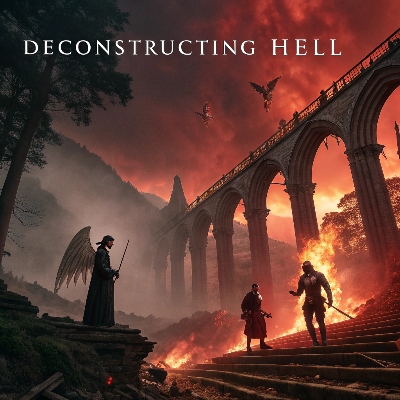
It is very in vogue today to minimize the doctrine and ostensibly the very existence of hell despite the fact that Jesus taught very clearly that it is a place, a state of separation from God, and resulting punishment. To be clear, this isn’t about generating fear. It’s a serious look at divine justice, human freedom, all based on the sources you sent us.
Our goal here really is to get past the common ideas, the cultural images, and to look at precisely what the Bible teaches about eternity, divine justice, and the consequences of free will. In bringing this subject up, most everyone thinks of Dante’s Inferno, right? We want to dig, however, into the actual source material, the Bible’s theological writings, to give you the core facts, a clear, informed view. Okay, great. So let’s dive straight into Jesus’s own teachings.
There’s a common claim that Jesus spoke more about hell than he did about heaven, right? You hear that a lot. But when you actually count it up in the gospels, the picture’s quite different. Jesus mentioned heaven or the kingdom about 167 times. Compare that to hell or fire, which comes up only around 32 times, so that’s over five times more.
The fact that Jesus spoke more of heaven and the kingdom rather than hell really flips the common script. But the raw number isn’t the whole story. Why? Well, because establishing Bible backed doctrinal issues is less about how often something is said but more about who is speaking, in this case, Jesus. Think about it, one really definitive statement from, say, the person in charge (Jesus) carries way more weight than lots of chatter from someone else.
Jesus’ warnings, even if fewer come from His ultimate authority, make His teachings and warnings incredibly significant. Something you really have to grapple with, and we need to be careful with the terms, too. You’ve got Sheol or Hades in Greek, which is more like the general place of the dead, but then Jesus uses Hades for the final judgment. That term pulls its imagery from the valley of Hinnom, which was, in ancient times, a perpetually burning garbage dump outside Jerusalem. A really stark image. Oh, and Tartarus also pops up once. So Gehenna is the key term from Jesus for that final state. It’s specific. It’s powerful. And he used stories, parables, didn’t he, to illustrate the separation, like the sheep and the goats, etc.
What about the story of the rich man and Lazarus? Passages such as this paint a vivid picture. And Jesus’ direct statements are pretty blunt, too. He talks about eternal fire, prepared for the devil and his angels. And that image of wailing and grinding of teeth, it really presents things as a stark, binary choice, and underscores the seriousness Jesus no doubt wanted His followers should consider when addressing this subject of hell and eternal punishment.
It is also important to consider different Christian traditions and how they approach this differently. The Catholic church, for instance, often defines hell as a definitive self-exclusion from communion with God. This comes from dying in a state of unrepentant, mortal sin. Your choices relating to the claims of Christ, whether explicit or inferred by your lifestyle, are sealed at death for heaven or hell.
What about salvation? By faith alone, salvation is seen as a gift you receive through faith. Good works aren’t what save you, but they’re expected to flow from a genuinely changed heart, in evidence of that faith. Right? And there’s the Eastern Orthodox view too. Briefly seeing heaven and hell, not as different places, but different experiences of the same presence of God. This is a fascinating angle, but what’s interesting is the common ground across these traditions; you often see hell framed as this definitive self-exclusion. It keeps coming back to human freedom, the weight of our choices. That idea of a definitive free choice is really central. Yeah. Okay, so building on that, what did the sources tell us about the nature of this state?
Is it eternal, conscious torment, active suffering forever, or is it annihilation (merely evaporating into non-existence)? That’s a major point of discussion. The broad-based theological positions across Christianity as a whole lean strongly towards eternal conscious torment. When the Bible uses words like destruction, the interpretation often points to ruin or loss, not annihilation. Think of a destroyed city. It’s still there as ruins, but it’s lost its purpose, its function, and it’s ruined. The powerful images, eternal fire, and outer darkness are likely metaphors, not literal descriptions, but ways to convey a reality that’s well. Far worse than we can properly imagine. Okay? Metaphor is pointing to something truly awful.
But if hell is only metaphorical, how does that connect with divine justice? Is the punishment the same for everyone? That’s a crucial question, and the sources actually suggest, no, it’s not uniform. The Bible talks about degrees of punishment. Jesus himself says it will be more tolerable for Sodom on judgment day than for towns that rejected his message. Jesus also tells a parable where a servant’s punishment depends on whether they knew the master’s will and still disobeyed. It implies a proportional justice, which is somewhat reassuring actually. It reflects individual knowledge and accountability, right? Proportional justice. Now let’s touch on Dante.
Dante’s Inferno, over the centuries since its publication, is probably the dominant cultural image of hell. It’s so powerful, but how does it stack up against the actual theology? Dante’s impact is huge, but it’s absolutely critical to remember that it has no authority to establish doctrine but is simply a literary masterpiece, a work of religious poetry, not a theological rule book.
There are big differences in Dante that comprise a sizable departure from standard doctrine. Dante includes purgatory, which isn’t accepted by all traditions. He creates this incredibly detailed hierarchy of nine circles of hell, and his work might imply chances for change after death, which isn’t typical Biblical teaching. You could read Dante’s Journey through Hell as a kind of purgatory for Dante, the Pilgrim himself. Ah, so it’s about his own journey, his own understanding, sort of, it’s like an anti-narrative. It explores the horrifying perfection of choosing wickedness, showing where unrepentant sin ultimately leads. It functions morally for you, the reader. It forces you to confront the nature of sin and its consequences in a really dramatic way. It’s not, however, about giving you a geographical coordinate for hell. Hmm. Pulling it all together, the theology of the Church throughout its history affirms hell is a real, eternal possibility. It’s presented as the outcome of a free final choice to reject and self-exclude oneself from communion with God.
The point isn’t just to scare people. It’s meant to highlight the incredibly precious offer of salvation through Christ. And that leaves us with something to think about as concerns our temporal choices day by day and for our lives in general that have eternal consequences of immense importance. Given that these sources generally describe eternity as fixed at death, and the choices we make now in this life have permanent weight. What does that tell you about how much God values your freedom, and what’s the real gravity of the true weight of every single choice you make today?
Summary
- Biblical Foundation of Hell: Contrary to popular belief, Jesus mentioned heaven and the kingdom of God over five times more often than hell. However, the significance of Jesus’s warnings about hell lies not in their frequency but in his ultimate authority as the speaker.
- Terminology and Imagery: The Bible uses terms like Gehenna to describe hell, referencing a perpetually burning garbage dump outside Jerusalem to convey a stark and powerful image of separation and judgment. This contrasts with more general terms like Sheol or Hades, which refer to the general state of the dead.
- Nature of Hell and Divine Justice: The concept of hell is often defined as definitive self-exclusion from God due to unrepentant sin, a perspective shared across different Christian traditions. While the Bible uses strong metaphorical language like “eternal fire” and “wailing and grinding of teeth,” these are meant to convey a terrible reality rather than a literal geographical location. Divine justice is also shown to be proportional, with the Bible suggesting degrees of punishment based on knowledge and accountability.
- Eternal Consequence vs. Annihilation: The dominant theological view within Christianity is that hell involves eternal conscious torment rather than annihilation, with biblical “destruction” interpreted as ruin or loss of purpose, not non-existence.
- Dante’s Inferno vs. Biblical Doctrine: Dante’s work is a powerful literary masterpiece but has no authority to establish Christian doctrine. It differs from biblical teachings by creating a detailed hierarchy of punishment and including concepts like purgatory that are not universally accepted. The true value of Dante’s work lies in its moral function, forcing the reader to confront the consequences of sin.
Conclusion
The core theological understanding of hell across major Christian traditions is a reality of eternal separation from God, which is a direct and serious consequence of human free will. It is not an arbitrary punishment from a vengeful God but the definitive result of an individual’s final, free choice to reject God’s communion and grace. The seriousness of this consequence highlights the immense value God places on human freedom and underscores the importance of the choices made during one’s lifetime.
Selah
Discover more from Fathers Heart Ministry
Subscribe to get the latest posts sent to your email.