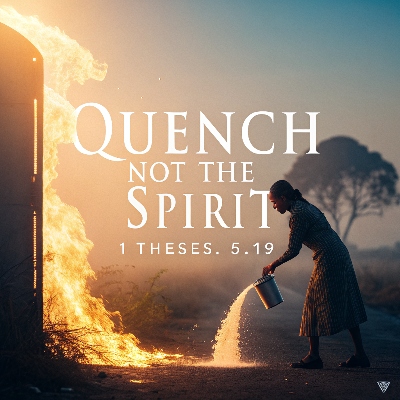
In 1 Thessalonians 5:19, the apostle Paul writes, “Quench Not the Spirit,” which is a powerful admonition about our relationship with the Holy Spirit, the third person of the Trinity.
What does “Quench Not the Spirit” mean?
The word “quench” (Greek: sbennumi) literally means to extinguish, put out, or stifle a fire. The Holy Spirit is often associated with fire in the Bible (e.g., tongues of fire at Pentecost in Acts 2:3-4). Therefore, “quenching the Spirit” means to suppress, hinder, or extinguish the Spirit’s work, influence, and manifestations in our lives, both individually and corporately in the church.
It’s not about the Spirit ceasing to exist or being destroyed, as the Holy Spirit is the eternal God. Rather, it refers to our actions and attitudes that prevent His activity and power from flowing freely through us and among us. When we quench the Spirit, we essentially dim the “fire” of His presence and work.
Examples of how this happens:
- Disobedience and willful sin: This is perhaps the most direct way to quench the Spirit. When we knowingly choose to act against God’s revealed will, it grieves the Holy Spirit (Ephesians 4:30) and hinders His work within us. This includes both overt acts of sin and “invisible” sins like unforgiveness, bitterness, jealousy, or harboring evil thoughts.
- Neglecting spiritual disciplines:
- Neglecting prayer: Prayer is our communication with God and the Spirit. When we neglect prayer, we cut off vital connection and limit the Spirit’s ability to guide and empower us.
- Neglecting God’s Word: The Bible is inspired by the Spirit. Failing to read, meditate on, and apply God’s Word means we are not allowing the Spirit to teach, correct, and illuminate our understanding.
- Neglecting fellowship and corporate worship: The Holy Spirit works in the community of believers. Isolating ourselves or treating corporate worship casually can hinder the Spirit’s manifest presence and work among God’s people.
- Apathy and lukewarmness: When we become indifferent to spiritual things, lacking zeal or passion for God and His kingdom, we are effectively cooling down the fire of the Spirit within us. This can manifest as a lack of desire to serve, share the Gospel, or grow spiritually.
- Unbelief and doubt: The Spirit often moves in extraordinary ways, including through spiritual gifts. If we doubt the Spirit’s power or refuse to believe He still works supernaturally today, we can limit His operations. This can also apply to doubting His guidance in specific situations.
- Legalism and rigid traditions: Sometimes, human rules, traditions, or a rigid theological framework can stifle the spontaneous and dynamic work of the Spirit. This can manifest as being unwilling to allow for new expressions of worship, prophetic utterances, or other spiritual gifts because they don’t fit preconceived notions.
- Criticism and negativity towards spiritual manifestations: Being quick to criticize or dismiss genuine manifestations of the Spirit, particularly prophetic words or expressions of worship, can create an atmosphere where the Spirit’s activity is suppressed.
- Focusing on worldly pursuits over spiritual ones: When our primary focus and energy are consumed by earthly ambitions, material possessions, or fleeting pleasures, it can dim the spiritual fire within us, drawing us away from God’s priorities.
Suggestions as to how we can avoid doing this:
- Cultivate a sensitive heart: Be sensitive to the Holy Spirit’s promptings, convictions, and guidance. Learn to discern His voice and be quick to obey.
- Prioritize spiritual disciplines:
- Consistent prayer: Engage in regular, fervent prayer, both individually and with other believers.
- Diligent study of God’s Word: Immerse yourself in the Bible, allowing the Spirit to illuminate its truths and transform your mind.
- Active participation in Christian community: Be an active member of a local church, participating in worship, fellowship, and ministry.
- Live a life of obedience: Strive to walk in obedience to God’s commands, repenting quickly when you fall short. Confess sin and seek forgiveness, knowing that God’s grace abounds.
- Embrace spiritual gifts: Be open to and actively seek the spiritual gifts that the Holy Spirit distributes for the building up of the church (1 Corinthians 12, Romans 12). Don’t despise prophetic utterances (1 Thessalonians 5:20), but test everything and hold fast to what is good (1 Thessalonians 5:21).
- Maintain a thankful and joyful attitude: Cultivate an attitude of gratitude and joy, as these are often products of the Spirit’s work and create an environment where He can thrive.
- Guard your thoughts and heart: Be mindful of what you allow into your mind and heart through media, conversations, and personal thoughts. “Whatever is true, whatever is noble, whatever is right, whatever is pure, whatever is lovely, whatever is admirable—if anything is excellent or praiseworthy—think about such things” (Philippians 4:8).
- Seek to be continually filled with the Spirit: As Ephesians 5:18 exhorts, “be filled with the Spirit.” This is a continuous, ongoing process, not a one-time event. It involves yielding to His control and allowing Him to empower you for godly living and service.
In essence, “Quench Not the Spirit” is a call to actively cooperate with the Holy Spirit, allowing Him to work freely and powerfully in our lives, leading us into greater holiness, service, and intimacy with God.
Call to Action:
- Pray Daily: Start and end your day with intentional prayer, inviting the Holy Spirit to guide your thoughts and actions.
- Read & Reflect: Commit to daily engagement with God’s Word, allowing the Spirit to reveal its truths and transform your perspective.
- Serve Actively: Find a way to actively serve in your local church or community, allowing the Spirit to use your gifts for His glory.
- Practice Repentance: Be quick to confess and repent of sin, maintaining a clear conscience and an open channel for the Spirit’s leading.
- Embrace the Unseen: Be open to and pray for the manifestation of spiritual gifts, trusting that the Holy Spirit still works powerfully today.
Discover more from Fathers Heart Ministry
Subscribe to get the latest posts sent to your email.